
I'm Matt, and after years of playing rugby and now working as a strength and conditioning coach, I've spent more time in gyms than I care to admit. And in that time, I've developed what I can only describe as a highly specialised skill: the ability to interpret gym noises.
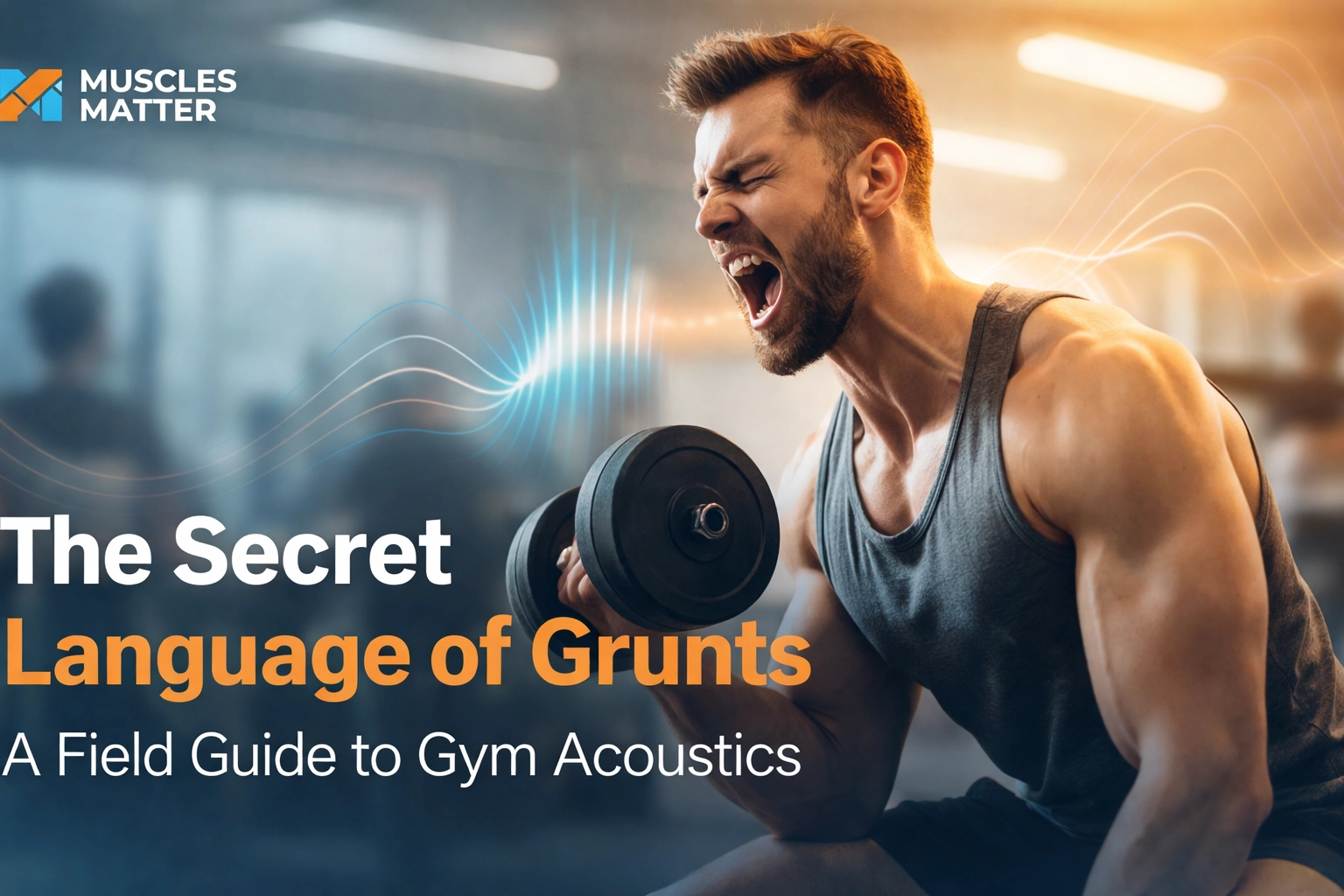
You know the ones. The grunts, groans, sighs, and occasional sounds that make you wonder if someone's lifting weights or auditioning for a nature documentary. Every gym has its own soundtrack, and once you start paying attention, you realise there's actually a complex language being spoken.
So today, I'm presenting my definitive field guide to gym acoustics. Consider this your Rosetta Stone for understanding what's really being communicated between the clanging of plates and the whirring of treadmills.
The Science Bit (Because Yes, Grunting Actually Works)
Before we dive into the taxonomy of gym noises, let me hit you with something that might surprise you. Grunting isn't just for show. It actually does something.
Research has shown that grunting during explosive movements can increase your power output by approximately 10 percent. That's not nothing! The mechanism is pretty straightforward: when you grunt, you're creating a sharp, forceful exhale that helps brace your core and generate more power.

It's essentially activating your fight-or-flight response, which allows for more complete and forceful muscle contractions. So the next time someone side-eyes you for making noise during a heavy deadlift, you can smugly inform them it's a "biomechanical technique."
That said, the benefit comes from the mechanics of the exhale, not necessarily from how loud you are. A controlled, directed push of air does the job. You don't actually need to sound like a wounded buffalo to get the performance benefit.
But where's the fun in that?
Category 1: The Power Grunt
Sound profile: A deep, controlled "HNNNNGH" that builds in intensity with the lift.
When you'll hear it: Heavy compound lifts. Deadlifts, squats, bench press. The classics.
What it actually means: "I am currently recruiting every muscle fibre in my body and this is genuinely difficult."
This is the legitimate grunt. The one backed by science. As a strength and conditioning coach, I actually encourage this one. It's the sound of someone working hard and using their breath properly to stabilise their core.
The Power Grunt is usually proportional to the effort being exerted. The heavier the weight, the more substantial the grunt. It's honest. It's functional. And it's completely acceptable.
Respect level: High. Carry on, soldier.
Category 2: The Ego Grunt
Sound profile: Unnecessarily loud "YEAHHHHH" or "COME ONNNNN" often accompanied by aggressive plate-slamming.
When you'll hear it: Usually during moderately heavy lifts that don't quite warrant this level of audio drama.
What it actually means: "I would like everyone in this gym to know that I am lifting weights right now."

Look, we've all been there. Sometimes you need to hype yourself up. But there's a difference between genuine effort and performing for an audience. The Ego Grunt is usually about 40% louder than the weight actually requires.
The tell-tale sign? They look around afterwards to see who noticed.
Respect level: Moderate. We see you, mate. We see you.
Category 3: The Taco Regret Grunt
Sound profile: A strained, slightly panicked "urrrrghhh" often followed by a pause and some deep breathing.
When you'll hear it: Mid-set, usually during anything that puts pressure on the midsection. Squats are a classic trigger.
What it actually means: "I have made a significant dietary error in the past 24 hours and I am now facing the consequences."
This is the sound of someone remembering, mid-rep, that last night's kebab was perhaps not the ideal pre-workout meal. It's part grunt, part prayer, part negotiation with their own digestive system.
As someone who focuses on injury prevention with my online personal training clients, I always say nutrition matters. This grunt is the universe's way of reinforcing that lesson.
Respect level: Sympathetic. We've all had that moment.
Category 4: The "I'm Fine, Everything's Fine" Sigh
Sound profile: A long, deflating exhale. Like a balloon slowly losing air. "Huuuuuhhhhh."
When you'll hear it: Cardio machines. Especially treadmills around the 15-minute mark.
What it actually means: "I don't want to be here. I would rather be literally anywhere else. Why did I think this was a good idea?"

This isn't really a grunt at all. It's an existential expression. The "I'm Fine" Sigh is the sound of someone questioning every life choice that led them to this moment, staring at a screen that says they've burned 47 calories.
These people deserve our compassion. Maybe even a supportive nod.
Respect level: High. Cardio is boring. They're doing it anyway. Heroes.
Category 5: The Unexpected Noise
Sound profile: A sudden, unplanned sound that surprises even the person who made it. Could be anything from a squeak to a full-on yelp.
When you'll hear it: During heavy lifts, sudden movements, or when someone nearly drops something on themselves.
What it actually means: "That was significantly harder than I anticipated" or "I have just narrowly avoided injury."
This is the most honest sound in the gym. It's completely involuntary. No performance, no ego, just pure, unfiltered human reaction to physical stress.
As someone who spends a lot of time helping people with injury prevention, I actually pay attention to these. Sometimes an unexpected noise is the body's way of saying "something isn't right here." If you're regularly making surprised noises during lifts, it might be worth checking your form with a coach.
Respect level: Understanding. Been there. Will be there again.
Category 6: The Breathing Purist
Sound profile: Controlled, rhythmic exhales. "Tssss… tssss… tssss."
When you'll hear it: Throughout sets, perfectly timed with each rep.
What it actually means: "I have watched several YouTube videos about breathing technique and I am implementing my knowledge."
This is actually the gold standard. Proper breathing technique, controlled exhales on the exertion phase, no unnecessary noise. It's efficient. It's effective.
It's also slightly intimidating because it suggests this person knows what they're doing.
Respect level: Maximum. This is the way.
The Unwritten Rules of Gym Acoustics
Right, so now you can identify the various species of gym grunt. But there are some unwritten rules to navigate this world:
-
Headphones are not soundproofing. Just because you can't hear yourself doesn't mean others can't. The number of people I've seen absolutely bellowing along to music while everyone else exchanges concerned glances is… high.
-
Volume should be proportional to effort. Grunting during a max-effort deadlift? Acceptable. Grunting while doing bicep curls with 5kg dumbbells? Questionable.
-
The "sorry" nod exists for a reason. If you accidentally let out a noise that was louder than intended, a brief apologetic nod to nearby gym-goers smooths everything over.
-
Some silence is golden. Not every rep needs audio accompaniment. Save the noise for when it actually helps.
The Bottom Line
Here's the thing: gyms are meant to be places where people work hard. And working hard sometimes involves making noise. That's completely fine.
Whether you're a Power Grunter, a reformed Ego Grunter, or someone who's recently discovered the joy of controlled breathing, you're all welcome. Even the Taco Regret crew. Especially the Taco Regret crew, actually. You've learned an important lesson.
If you're looking for guidance on your training: including how to breathe properly so you're not the subject of someone else's field guide: I offer online personal training that covers all the basics and then some.
Now get out there and grunt responsibly.
Recent Comments